Posts

Showing posts with the label Machine Learning

Emerging Architectures for Modern Data Infrastructure

Image
As an industry, we’ve gotten exceptionally good at building large, complex software systems. We’re now starting to see the rise of massive, complex systems built around data – where the primary business value of the system comes from the analysis of data, rather than the software directly. We’re seeing quick-moving impacts of this trend across the industry, including the emergence of new roles, shifts in customer spending, and the emergence of new startups providing infrastructure and tooling around data. In fact, many of today’s fastest growing infrastructure startups build products to manage data. These systems enable data-driven decision making (analytic systems) and drive data-powered products, including with machine learning (operational systems). They range from the pipes that carry data, to storage solutions that house data, to SQL engines that analyze data, to dashboards that make data easy to understand – from data science and machine learning libraries, to automated data pipe...

The DataOps Landscape

Image
Data has emerged as an imperative foundational asset for all organizations. Data fuels significant initiatives such as digital transformation and the adoption of analytics, machine learning, and AI. Organizations that are able to tame, manage, and unlock their data assets stand to benefit in myriad ways, including improvements to decision-making and operational efficiency, better fraud prediction and prevention, better risk management and control, and more. In addition, data products and services can often lead to new or additional revenue. As companies increasingly depend on data to power essential products and services, they are investing in tools and processes to manage essential operations and services. In this post, we describe these tools as well as the community of practitioners using them. One sign of the growing maturity of these tools and practices is that a community of engineers and developers are beginning to coalesce around the term “DataOps” (data operations). Our conver...

Automated Data Wrangling

Image
  A growing array of techniques apply machine learning directly to the problems of data wrangling. They often start out as open research projects but then become proprietary. How can we build automated data wrangling systems for open data? We work with a lot of messy public data. In theory it’s already “structured” and published in machine readable forms like Microsoft Excel spreadsheets, poorly designed databases, and CSV files with no associated schema. In practice it ranges from almost unstructured to… almost structured. Someone working on one of our take-home questions for the data wrangler & analyst position recently noted of the FERC Form 1: “This database is not really a database – more like a bespoke digitization of a paper form that happened to be built using a database.” And I mean, yeah. Pretty much. The more messy datasets I look at, the more I’ve started to question Hadley Wickham’s famous Tolstoy quip about the uniqueness of messy data. There’s a taxonomy of diffe...

The Growing Importance of Metadata Management Systems

Image
As companies embrace digital technologies to transform their operations and products, many are using best-of-breed software, open source tools, and software as a service (SaaS) platforms to rapidly and efficiently integrate new technologies. This often means that data required for reports, analytics, and machine learning (ML) reside on disparate systems and platforms. As such, IT initiatives in companies increasingly involve tools and frameworks for data fusion and integration. Examples include tools for building data pipelines, data quality and data integration solutions, customer data platform ( CDP ) ,   master data management , and   data markets . Collecting, unifying, preparing, and managing data from diverse sources and formats has become imperative in this era of rapid digital transformation. Organizations that invest in  foundational data technologies  are much more likely to build solid foundation applications, ranging from BI and analytics to machine learn...

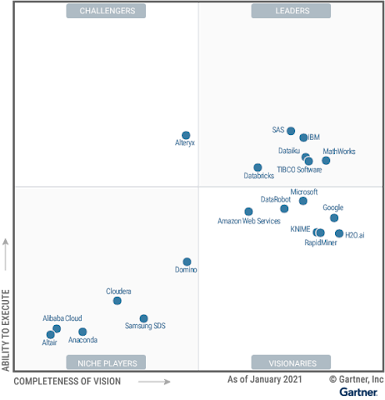
Gartner Magic Quadrant for Data Science and Machine Learning Platforms 2021

Image
This report assesses 20 vendors of platforms that data scientists and others can use to source data, build models and operationalize machine learning. It will help them make the right choice from a crowded field in a maturing DSML platform market that continues to show rapid product development. Market Definition/Description Gartner  defines a data science and machine learning (DSML) platform as a core product and supporting portfolio of coherently integrated products, components, libraries and frameworks (including proprietary, partner-sourced and open-source). Its primary users are data science professionals, including expert data scientists, citizen data scientists, data engineers, application developers and machine learning (ML) specialists. The core product and supporting portfolio: Are sufficiently well-integrated to provide a consistent “look and feel.” Create a user experience in which all components are reasonably interoperable in support of an analytics pipeline. The...

AIOps Platforms (Gartner)

Image
AIOps is an emerging technology and addresses something I’m a big fan of – improving IT Operations.  So I asked fellow Gartner analyst Colin Fletcher for a guest blog on the topic… Roughly three years ago, it was looking like we were going to see many enterprise IT operations leaders put themselves in the precarious role of “ the cobbler’s children ” by forgoing investment in Artificial Intelligence (AI) to help them do their work better, faster, and cheaper. We were hearing from many IT ops leaders building incredibly sophisticated Big Data and Advanced Analytics systems for business stakeholders, but were themselves using rudimentary, reactive red/yellow/green lights and manual steps to help run the infrastructure required to keep those same systems up and running. Further, we’re all now familiar in our personal lives with dynamic recommendations from online retailers, search providers, virtual personal assistants, and entertainment services, Talk about a paradox! Now I...

The unreasonable importance of data preparation

Image
We know data preparation requires a ton of work and thought. In this provocative article, Hugo Bowne-Anderson provides a formal rationale for why that work matters, why data preparation is particularly important for reanalyzing data, and why you should stay focused on the question you hope to answer. Along the way, Hugo introduces how tools and automation can help augment analysts and better enable real-time models. In a world focused on buzzword-driven models and algorithms, you’d be forgiven for forgetting about the unreasonable importance of data preparation and quality: your models are only as good as the data you feed them. This is the garbage in, garbage out principle: flawed data going in leads to flawed results, algorithms, and business decisions. If a self-driving car’s decision-making algorithm is trained on data of traffic collected during the day, you wouldn’t put it on the roads at night. To take it a step further, if such an algorithm is trained in an environment with car...

Gartner’s 2020 Magic Quadrant For Data Science And Machine Learning Platforms

Image
Expert data scientists and other professionals working in data science roles require capabilities to source data, build models and operationalize machine learning insights. Significant vendor growth, product development and myriad competing visions reflect a healthy market that is maturing rapidly. This Magic Quadrant evaluates vendors of data science and machine learning (DSML) platforms. Gartner defines a DSML platform as a core product and supporting portfolio of coherently integrated products, components, libraries and frameworks (including proprietary, partner and open source). Its primary users are data science professionals. These include expert data scientists, citizen data scientists, data engineers and machine learning (ML) engineers/specialists. Coherent integration means that the core product and supporting portfolio provide a consistent “look and feel” and create a user experience where all components are reasonably interoperable in support of an analytics pipel...

Researchers love PyTorch and TensorFlow

Image
In a recent survey—AI Adoption in the Enterprise, which drew more than 1,300 respondents—we found significant usage of several machine learning (ML) libraries and frameworks. About half indicated they used TensorFlow or scikit-learn, and a third reported they were using PyTorch or Keras. I recently attended an interesting RISELab presentation delivered by Caroline Lemieux describing recent work on AutoPandas and automation tools that rely on program synthesis. In the course of her presentation, Lemieux reviewed usage statistics they had gathered on different deep learning frameworks and data science libraries. She kindly shared some of that data with me, which I used to draw this chart: The numbers are based on simple full-text searches of papers posted on the popular e-print service arXiv.org. Specifically, they reflect the number of papers which mention (in a full-text search) each of the frameworks. Using this metric, the two most popular deep learning frameworks among resear...

2019 Datanami Readers’ and Editors’ Choice Awards

Image
Datanami  is pleased to announce the results of its fourth annual Readers’ and Editors’ Choice Awards, which recognizes the companies, products, and projects that have made a difference in the big data community this year. These awards, which are nominated and voted on by Datanami readers, give us insight into the state of the community. We’d like to thank our dedicated readers for weighing in on their top picks for the best in big data. It’s been a privilege for us to present these awards, and we extend our congratulations to this year’s winners. Best Big Data Product or Technology: Machine Learning Readers’ Choice: Elastic Editor’s Choice: SAS Visual Data Mining & Machine Learning Best Big Data Product or Technology: Internet of Things Readers’ Choice: SAS Analytics for IoT Editor’s Choice:  The Striim Platform Best Big Data Product or Technology: Big Data Security Readers’ Choice: Cloudera Enterprise Editor’s Choice: Elastic Stack Best Big ...

Top 10 AI Jobs, Salaries and Cities 2019

We discovered that machine learning engineer job postings had the highest percentage of AI and machine learning keywords this year (as they did in 2018). Machine learning engineers develop devices and software that use predictive technology, such as Apple’s Siri or weather-forecasting apps. They ensure machine learning algorithms have the data that needs to be processed and analyze huge amounts of real-time data to make machine learning models more accurate. While machine learning engineer jobs still have the largest number of postings containing the relevant keywords, in 2018, they composed a greater percentage of these postings (94.2%, versus 75% in 2019). Many of the jobs requiring AI skills on 2019’s top 10 were nowhere to be found on 2018’s list — such as deep learning engineer, appearing for the first time in second place. Deep learning engineers develop programming systems that mimic brain functions, among other tasks. These engineers are key players in three rapidly growing fie...