Posts

Showing posts with the label Data Catalog

The Growing Importance of Metadata Management Systems

Image
As companies embrace digital technologies to transform their operations and products, many are using best-of-breed software, open source tools, and software as a service (SaaS) platforms to rapidly and efficiently integrate new technologies. This often means that data required for reports, analytics, and machine learning (ML) reside on disparate systems and platforms. As such, IT initiatives in companies increasingly involve tools and frameworks for data fusion and integration. Examples include tools for building data pipelines, data quality and data integration solutions, customer data platform ( CDP ) ,   master data management , and   data markets . Collecting, unifying, preparing, and managing data from diverse sources and formats has become imperative in this era of rapid digital transformation. Organizations that invest in  foundational data technologies  are much more likely to build solid foundation applications, ranging from BI and analytics to machine learn...

Ten Use Cases to Enable an Organization with Metadata and Catalogs

Image
Enterprises are modernizing their data platforms and associated tool-sets to serve the fast needs of data practitioners, including data scientists, data analysts, business intelligence and reporting analysts, and self-service-embracing business and technology personnel. However, as the tool-stack in most organizations is getting modernized, so is the variety of metadata generated. As the volume of data is increasing every day, thereupon, the metadata associated with data is expanding, as is the need to manage it. The first thought that strikes us when we look at a data landscape and hear about a catalog is, “It scans any database ranging from Relational to NoSQL or Graph and gives out useful information.” Name Modeled data-type Inferred data types Patterns of data Length with minimum and largest threshold Minimal and maximum values Other profiling characteristics of data like frequency of values and their distribution What Is the Basic Benefit of Metadata Managed in Catal...

Gartner - 2020 Magic Quadrant for Metadata Management Solutions

Image
Metadata management is a core aspect of an organization’s ability to manage its data and information assets. The term “metadata” describes the various facets of an information asset that can improve its usability throughout its life cycle. Metadata and its uses go far beyond technical matters. Metadata is used as a reference for business-oriented and technical projects, and lays the foundations for describing, inventorying and understanding data for multiple use cases. Use-case examples include data governance, security and risk, data analysis and data value. The market for metadata management solutions is complex because these solutions are not all identical in scope or capability. Vendors include companies with one or more of the following functional capabilities in their stand-alone metadata management products (not all vendors offer all these capabilities, and not all vendor solutions offer these capabilities in one product): Metadata repositories — Used to document and manage meta...

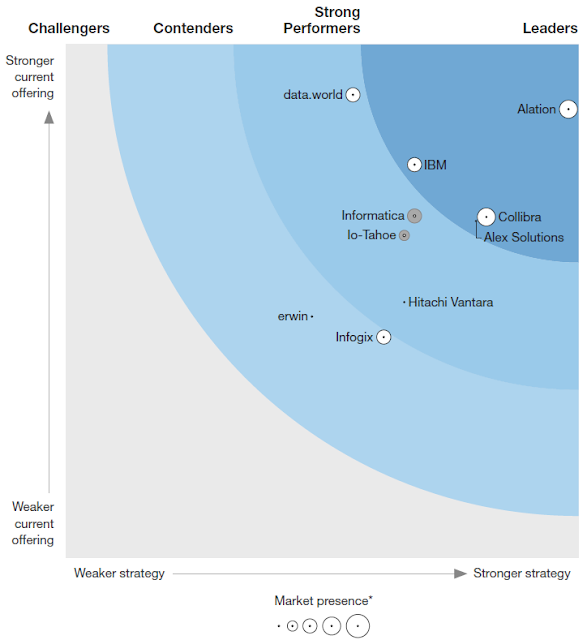
The Forrester Wave™: Machine Learning Data Catalogs, Q4 2020

Image
Key Takeaways  Alation, Collibra, Alex Solutions, And IBM Lead The Pack Forrester’s research uncovered a market in which Alation, Collibra, Alex Solutions, and IBM are Leaders; data.world, Informatica, Io-Tahoe, and Hitachi Vantara are Strong Performers; and Infogix and erwin are Contenders.  Collaboration, Lineage, And Data Variety Are Key Differentiators As metadata and business glossary technology becomes outdated and less effective, improved machine learning will dictate which providers lead the pack. Vendors that can provide scaleout collaboration, offer detailed data lineage, and interpret any type of data will position themselves to successfully deliver contextualized, trusted, accessible data to their customers. Read full report >>>