Posts

Showing posts with the label Data Management

Data Reliability at Scale: How Fox Digital Architected its Modern Data Stack

Image
  As distributed architectures continue to become a new gold standard for data driven organizations, this kind of self-serve motion would be a dream come true for many data leaders. So when the Monte Carlo team got the chance to sit down with Alex, we took a deep dive into how he made it happen.  Here’s how his team architected a hybrid data architecture that prioritizes democratization and access, while ensuring reliability and trust at every turn. Exercise “Controlled Freedom” when dealing with stakeholders Alex has built decentralized access to data at Fox on a foundation he calls “controlled freedom.” In fact, he believes using your data team as the single source of truth within an organization actually creates the biggest silo.  So instead of becoming a guardian and bottleneck, Alex and his data team focus on setting certain parameters around how data is ingested and supplied to stakeholders. Within the framework, internal data consumers at Fox have the freedom to cr...

Top 9 Data Modeling Tools & Software 2021

Image
  Data modeling is the procedure of crafting a visual representation of an entire information system or portions of it in order to convey connections between data points and structures. The objective is to portray the types of data used and stored within the system, the ways the data can be organized and grouped, the relationships among these data types, and their attributes and formats. Data modeling uses abstraction to better understand and represent the nature of the flow of data within an enterprise-level information system.  The types of data models include: Conceptual data models. Logical data models. Physical data models. Database and information system design begins with the creation of these data models.  What is a Data Modeling Tool? A data modeling tool enables quick and efficient database design while minimizing human error. A data modeling software helps craft a high-performance database, generate reports that can be useful for stakeholders and create data de...

The DataOps Landscape

Image
Data has emerged as an imperative foundational asset for all organizations. Data fuels significant initiatives such as digital transformation and the adoption of analytics, machine learning, and AI. Organizations that are able to tame, manage, and unlock their data assets stand to benefit in myriad ways, including improvements to decision-making and operational efficiency, better fraud prediction and prevention, better risk management and control, and more. In addition, data products and services can often lead to new or additional revenue. As companies increasingly depend on data to power essential products and services, they are investing in tools and processes to manage essential operations and services. In this post, we describe these tools as well as the community of practitioners using them. One sign of the growing maturity of these tools and practices is that a community of engineers and developers are beginning to coalesce around the term “DataOps” (data operations). Our conver...

Automated Data Wrangling

Image
  A growing array of techniques apply machine learning directly to the problems of data wrangling. They often start out as open research projects but then become proprietary. How can we build automated data wrangling systems for open data? We work with a lot of messy public data. In theory it’s already “structured” and published in machine readable forms like Microsoft Excel spreadsheets, poorly designed databases, and CSV files with no associated schema. In practice it ranges from almost unstructured to… almost structured. Someone working on one of our take-home questions for the data wrangler & analyst position recently noted of the FERC Form 1: “This database is not really a database – more like a bespoke digitization of a paper form that happened to be built using a database.” And I mean, yeah. Pretty much. The more messy datasets I look at, the more I’ve started to question Hadley Wickham’s famous Tolstoy quip about the uniqueness of messy data. There’s a taxonomy of diffe...

The Growing Importance of Metadata Management Systems

Image
As companies embrace digital technologies to transform their operations and products, many are using best-of-breed software, open source tools, and software as a service (SaaS) platforms to rapidly and efficiently integrate new technologies. This often means that data required for reports, analytics, and machine learning (ML) reside on disparate systems and platforms. As such, IT initiatives in companies increasingly involve tools and frameworks for data fusion and integration. Examples include tools for building data pipelines, data quality and data integration solutions, customer data platform ( CDP ) ,   master data management , and   data markets . Collecting, unifying, preparing, and managing data from diverse sources and formats has become imperative in this era of rapid digital transformation. Organizations that invest in  foundational data technologies  are much more likely to build solid foundation applications, ranging from BI and analytics to machine learn...

Visualizing Data Timeliness at Airbnb

Image
  Imagine you are a business leader ready to start your day, but you wake up to find that your daily business report is empty — the data is late, so now you are blind. Over the last year, multiple teams came together to build  SLA Tracker , a visual analytics tool to facilitate a culture of data timeliness at Airbnb. This data product enabled us to address and systematize the following challenges of data timeliness: When  should a dataset be considered late? How   frequently  are datasets late? Why  is a dataset late? This project is a critical part of our efforts to achieve high data quality and required overcoming many technical, product, and organizational challenges in order to build. In this article, we focus on the  product design : the journey of how we designed and built data visualizations that could make sense of the deeply complex data of data timeliness. Continue reading >>>

Ten Use Cases to Enable an Organization with Metadata and Catalogs

Image
Enterprises are modernizing their data platforms and associated tool-sets to serve the fast needs of data practitioners, including data scientists, data analysts, business intelligence and reporting analysts, and self-service-embracing business and technology personnel. However, as the tool-stack in most organizations is getting modernized, so is the variety of metadata generated. As the volume of data is increasing every day, thereupon, the metadata associated with data is expanding, as is the need to manage it. The first thought that strikes us when we look at a data landscape and hear about a catalog is, “It scans any database ranging from Relational to NoSQL or Graph and gives out useful information.” Name Modeled data-type Inferred data types Patterns of data Length with minimum and largest threshold Minimal and maximum values Other profiling characteristics of data like frequency of values and their distribution What Is the Basic Benefit of Metadata Managed in Catal...

Data Management maturity models: a comparative analysis

Image
From the first glance, you can see that there are seven key Subject Areas where the Subject domains are located. These are: Data Data and System Design Technology, Governance Data Quality Security Related Capabilities. You can see that the difference in approaches to define the key Domains are rather big. It is not the purpose of this article to deliver a detailed analysis, but there is one striking observation I would like to share: the Subject domains and deliverables of these domains are being mixed with one another.  For example, let us have a look at Data governance. The domain ‘Data governance’ exists in four different models. Some other domains like ‘Data management strategy’, that appears in three models, is considered as a deliverable of Data Governance domain in other models, for example in DAMA model. Such a big difference of opinions on key Subject domains is rather confusing. Subject domain dimensions Subject domain dimensions are characteristics of (sub-) domains. It ...

A Rudimentary Guide to Metadata Management

Image
 According to IDC, the size of the global datasphere is projected to reach 163 ZB by 2025, leading to disparate data sources in legacy systems, new system deployments, and the creation of data lakes and data warehouses. Most organizations do not utilize the entirety of the data at their disposal for strategic and executive decision making.  Identifying, classifying, and analyzing data historically has relied on manual processes and therefore, in the current age consumes a lot of resources, with respect to time and monitory value. Defining metadata for the data owned by the organization is the first step in unleashing the organizational data’s maximum potential.  The numerous data types and data sources that are embedded in different systems and technologies over time are seldomly designed to work together. Thus, the applications or models used on multiple data types and data sources can potentially be compromised, rendering inaccurate analysis and conclusions.  Havin...

Protegrity Announces Support for Amazon Redshift to Secure Sensitive Cloud Data

Image
Protegrity, the data-security solutions provider, today announced support for Amazon Redshift, a fully-managed petabyte scale cloud data warehouse. Organizations with high data-security and IT requirements can now deploy Protegrity’s data de-identification technology in the Amazon Redshift environment. With its format-preserving vaultless tokenization capabilities, Protegrity goes beyond encryption to ensure data is protected at every step of the data lifecycle—from storing and moving to analyzing—no matter where it lives. By allowing protected data to be fully utilized without risk, Protegrity for Amazon Redshift enables customers to drive significantly more value and insights from sensitive data in the cloud. Building on Amazon Redshift’s comprehensive, built-in security capabilities available to customers at no extra cost, Protegrity protects the privacy of individuals by anonymizing data before it reaches Amazon Redshift. The combination of Protegrity and Amazon Redshift allows bus...

How DataOps Amplifies Data and Analytics Business Value

Image
DataOps techniques can provide a more agile and collaborative approach to building and managing data pipelines. The pandemic has accelerated the need for data and analytics leaders to deliver data and analytics insight faster, with higher quality and resiliency in the face of constant change. Organizations need to make better-informed and faster decisions with a focus on automation, real-time risk assessment and mitigation, continuous value delivery and agility. The point of DataOps is to change how people collaborate around data and how it is used in the organization  As a result, data and analytics leaders are increasingly applying DataOps techniques that provide a more agile and collaborative approach to building and managing data pipelines. What is DataOps? Gartner defines DataOps as a collaborative data management practice focused on improving the communication, integration and automation of data flows between data managers and data consumers across an organization. “The poi...

Data Observability Ushers In A New Era Enabling Golden Age Of Data

Image
Have we entered the Golden Age of Data? Modern enterprises are collecting, producing, and processing more data than ever before. According to a February 2020 IDG survey of data professionals, average corporate data volumes are increasing by 63% per month. 10% of respondents even reported that their data volumes double every month. Large companies are investing heavily to transform themselves into data-driven organizations that can quickly adapt to the fast pace of a modern economy. They gather huge amounts of data from customers and generate reams of data from transactions. They continuously process data in an attempt to personalize customer experiences, optimize business processes, and drive strategic decisions. The Real Challenge with Data In theory, breakthrough open-source technologies, such as Spark, Kafka, and Druid are supposed to help just about any organization benefit from massive amounts of customer and operational data just like they benefit Facebook, Apple, Google, Microso...

Gartner - 2020 Magic Quadrant for Metadata Management Solutions

Image
Metadata management is a core aspect of an organization’s ability to manage its data and information assets. The term “metadata” describes the various facets of an information asset that can improve its usability throughout its life cycle. Metadata and its uses go far beyond technical matters. Metadata is used as a reference for business-oriented and technical projects, and lays the foundations for describing, inventorying and understanding data for multiple use cases. Use-case examples include data governance, security and risk, data analysis and data value. The market for metadata management solutions is complex because these solutions are not all identical in scope or capability. Vendors include companies with one or more of the following functional capabilities in their stand-alone metadata management products (not all vendors offer all these capabilities, and not all vendor solutions offer these capabilities in one product): Metadata repositories — Used to document and manage meta...

Nemo: Data discovery at Facebook

Image
Large-scale companies serve millions or even billions of people who depend on the services these companies provide for their everyday needs. To keep these services running and delivering meaningful experiences, the teams behind them need to find the most relevant and accurate information quickly so that they can make informed decisions and take action. Finding the right information can be hard for several reasons. The problem might be discovery — the relevant table might have an obscure or nondescript name, or different teams might have constructed overlapping data sets. Or, the problem could be one of confidence — the dashboard someone is looking at might have been superseded by another source six months ago.  Many companies, such as Airbnb, Lyft, Netflix, and Uber, have built their own custom solutions for this challenge. For us, it was important to make the data discovery process simple and fast. Funneling everything through data experts to locate the necessary data each time we...

Gartner - Information as a Second Language: Enabling Data Literacy for Digital Society

Image
Digital society expects its citizens to “speak data.” Unless data and analytics  leaders treat information as the new second language of business,  government and communities, they will not be able to deliver the  competitive advantage and agility demanded by their enterprises. Key Challenges ■ Poor data literacy is the second highest inhibitor to progress, as reported by respondents to Gartner’s third annual Chief Data Oficer Survey, behind culture change and just ahead of lack of t alent and skills. ■ An information language barrier exists across business units and IT functions, rooted in ineffective communication across a wide range of diverse stakeholders. As a result, data and analytics leaders struggle to get their message across and information assets go underutilized. ■ Although academic and professional programs are beginning to address the disparity in talent  and skills, in many cases they reinforce the information language barrier with narrow content...

The Forrester Wave™: Machine Learning Data Catalogs, Q4 2020

Image
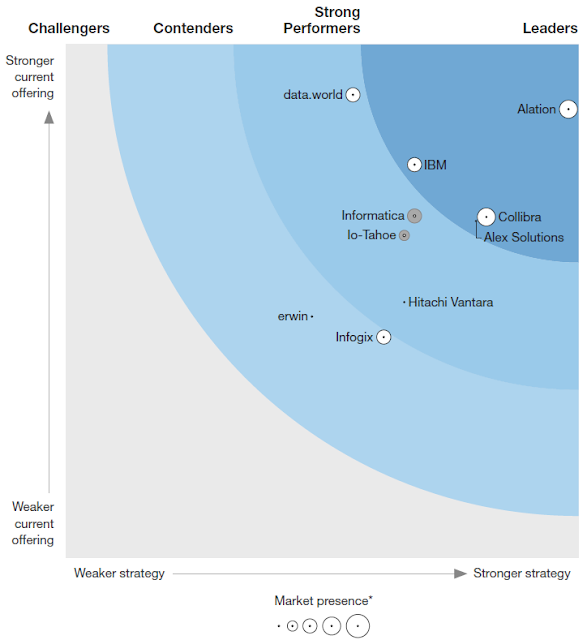
Key Takeaways  Alation, Collibra, Alex Solutions, And IBM Lead The Pack Forrester’s research uncovered a market in which Alation, Collibra, Alex Solutions, and IBM are Leaders; data.world, Informatica, Io-Tahoe, and Hitachi Vantara are Strong Performers; and Infogix and erwin are Contenders.  Collaboration, Lineage, And Data Variety Are Key Differentiators As metadata and business glossary technology becomes outdated and less effective, improved machine learning will dictate which providers lead the pack. Vendors that can provide scaleout collaboration, offer detailed data lineage, and interpret any type of data will position themselves to successfully deliver contextualized, trusted, accessible data to their customers. Read full report >>>

Only 3% of Companies’ Data Meets Basic Quality Standards

Image
Our analyses confirm that data is in far worse shape than most managers realize — and than we feared — and carry enormous implications for managers everywhere: On average, 47% of newly-created data records have at least one critical (e.g., work-impacting) error.  A full quarter of the scores in our sample are below 30% and half are below 57%. In today’s business world, work and data are inextricably tied to one another. No manager can claim that his area is functioning properly in the face of data quality issues. It is hard to see how businesses can survive, never mind thrive, under such conditions. Only 3% of the DQ scores in our study can be rated “acceptable” using the loosest-possible standard.  We often ask managers (both in these classes and in consulting engagements) how good their data needs to be. While a fine-grained answer depends on their uses of the data, how much an error costs them, and other company- and department-specific considerations, none has ever thought...

Shopify's approach to data discovery

Image
Humans generate a lot of data. Every two days we create as much data as we did from the beginning of time until 2003! The International Data Corporation estimates the global datasphere totaled 33 zettabytes (one trillion gigabytes) in 2018. The estimate for 2025 is 175 ZBs, an increase of 430%. This growth is challenging organizations across all industries to rethink their data pipelines. The nature of data usage is problem driven, meaning data assets (tables, reports, dashboards, etc.) are aggregated from underlying data assets to help decision making about a particular business problem, feed a machine learning algorithm, or serve as an input to another data asset. This process is repeated multiple times, sometimes for the same problems, and results in a large number of data assets serving a wide variety of purposes. Data discovery and management is the practice of cataloguing these data assets and all of the applicable metadata that saves time for data professionals, increasing data ...

Open sourcing DataHub: LinkedIn’s metadata search and discovery platform

Image
Finding the right data quickly is critical for any company that relies on big data insights to make data-driven decisions. Not only does this impact the productivity of data users (including analysts, machine learning developers, data scientists, and data engineers), but it also has a direct impact on end products that rely on a quality machine learning (ML) pipeline. Additionally, the trend towards adopting or building ML platforms naturally begs the question: what is your method for internal discovery of ML features, models, metrics, datasets, etc.? In this blog post, we will share the journey of open sourcing DataHub, our metadata search and discovery platform, starting with the project’s early days as WhereHows. LinkedIn maintains an in-house version of DataHub separate from the open source version. We will start by explaining why we need two separate development environments, followed by a discussion on the early approaches for open sourcing WhereHows, and a comparison of our inte...

The Ins and Outs of Data Acquisition: Beliefs and Best Practices

Image
Data acquisition involves the set of activities that are required to qualify and obtain external data — and also data that may be available elsewhere in an organization — and then to arrange for it to be brought into or accessed by the company. This strategy is on the rise as organizations leverage this data to get access to prospects, learn information about customers they already work with, be more competitive, develop new products and more. Standardizing data acquisition can be an afterthought at the tail-end of a costly data journey — if it’s considered at all. Now we see companies starting to pay more attention to the finer, critical points of data acquisition as the need for more data grows. And this is a good thing because ignoring acquisition best practices and proper oversight will lead to a whole host of problems that can outweigh the benefits of bringing in new data. The costly, problematic issues we see organizations grapple with include: Data purchases that, once brought i...