Posts

Showing posts with the label Data Science

Emerging Architectures for Modern Data Infrastructure

Image
As an industry, we’ve gotten exceptionally good at building large, complex software systems. We’re now starting to see the rise of massive, complex systems built around data – where the primary business value of the system comes from the analysis of data, rather than the software directly. We’re seeing quick-moving impacts of this trend across the industry, including the emergence of new roles, shifts in customer spending, and the emergence of new startups providing infrastructure and tooling around data. In fact, many of today’s fastest growing infrastructure startups build products to manage data. These systems enable data-driven decision making (analytic systems) and drive data-powered products, including with machine learning (operational systems). They range from the pipes that carry data, to storage solutions that house data, to SQL engines that analyze data, to dashboards that make data easy to understand – from data science and machine learning libraries, to automated data pipe...
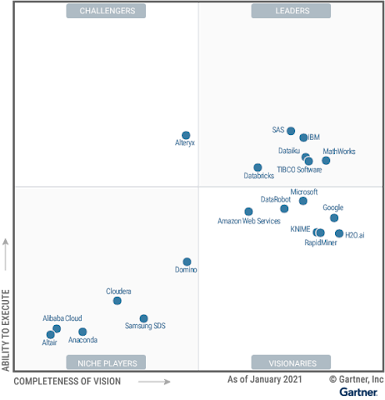
Gartner Magic Quadrant for Data Science and Machine Learning Platforms 2021

Image
This report assesses 20 vendors of platforms that data scientists and others can use to source data, build models and operationalize machine learning. It will help them make the right choice from a crowded field in a maturing DSML platform market that continues to show rapid product development. Market Definition/Description Gartner  defines a data science and machine learning (DSML) platform as a core product and supporting portfolio of coherently integrated products, components, libraries and frameworks (including proprietary, partner-sourced and open-source). Its primary users are data science professionals, including expert data scientists, citizen data scientists, data engineers, application developers and machine learning (ML) specialists. The core product and supporting portfolio: Are sufficiently well-integrated to provide a consistent “look and feel.” Create a user experience in which all components are reasonably interoperable in support of an analytics pipeline. The...

Turbocharging Analytics at Uber with Data Science Workbench

Image
Millions of Uber trips take place each day across nearly 80 countries, generating information on traffic, preferred routes, estimated times of arrival/delivery, drop-off locations, and more that enables us to facilitate better experiences for users. To make our data exploration and analysis more streamlined and efficient, we built Uber’s data science workbench (DSW), an all-in-one toolbox for interactive analytics and machine learning that leverages aggregate data. DSW centralizes everything a data scientist needs to perform data exploration, data preparation, ad-hoc analyses, model exploration, workflow scheduling, dashboarding, and collaboration in a single-pane, web-based graphical user interface (GUI). Leveraged by data science, engineering, and operations teams across the company, DSW has quickly scaled to become Uber’s go-to data analytics solution. Current DSW use cases include pricing, safety, fraud detection, and navigation, among other foundational elements of the trip experi...

The unreasonable importance of data preparation

Image
We know data preparation requires a ton of work and thought. In this provocative article, Hugo Bowne-Anderson provides a formal rationale for why that work matters, why data preparation is particularly important for reanalyzing data, and why you should stay focused on the question you hope to answer. Along the way, Hugo introduces how tools and automation can help augment analysts and better enable real-time models. In a world focused on buzzword-driven models and algorithms, you’d be forgiven for forgetting about the unreasonable importance of data preparation and quality: your models are only as good as the data you feed them. This is the garbage in, garbage out principle: flawed data going in leads to flawed results, algorithms, and business decisions. If a self-driving car’s decision-making algorithm is trained on data of traffic collected during the day, you wouldn’t put it on the roads at night. To take it a step further, if such an algorithm is trained in an environment with car...
Image
IEEE DataPort™ is a valuable and easily accessible data platform that enables users to store, search, access and manage data.  The data platform is designed to accept all formats and sizes of datasets (up to 2TB), and it provides both downloading capabilities and access to datasets in the Cloud.  IEEE DataPort™ is a universally accessible web-based portal that serves four primary purposes:   Enable individuals and institutions to indefinitely store and make datasets easily accessible to a broad set of researchers, engineers and industry;   Enable researchers, engineers and industry to gain access to datasets that can be analyzed to advance technology; Facilitate data analysis by enabling access to data in the AWS Cloud and by enabling the downloading of datasets Supports reproducible research. IEEE DataPort™ is an online data platform created and supported by IEEE and supports IEEE’s overall mission of Advancing Technology for Humanity. ...

Data Discovery for Data Scientists at Spotify

Image
Diagnosing the problem In 2016, as we started migrating to the Google Cloud Platform, we saw an explosion of dataset creation in BigQuery. At this time, we also drastically increased our hiring of insights specialists (data scientists, analysts, user researchers, etc.) at Spotify, resulting in more research and insights being produced across the company. However, research would often only have a localized impact in certain parts of the business, going unseen by others that might find it useful to influence their decision making. Datasets lacked clear ownership or documentation making it difficult for data scientists to find them. We believed that the crux of the problem was that we lacked a centralized catalog of these data and insights resources. In early 2017, we released Lexikon, a library for data and insights, as the solution to this problem. The first release allowed users to search and browse available BigQuery tables (i.e. datasets)— as well as discover k...

Gartner’s 2020 Magic Quadrant For Data Science And Machine Learning Platforms

Image
Expert data scientists and other professionals working in data science roles require capabilities to source data, build models and operationalize machine learning insights. Significant vendor growth, product development and myriad competing visions reflect a healthy market that is maturing rapidly. This Magic Quadrant evaluates vendors of data science and machine learning (DSML) platforms. Gartner defines a DSML platform as a core product and supporting portfolio of coherently integrated products, components, libraries and frameworks (including proprietary, partner and open source). Its primary users are data science professionals. These include expert data scientists, citizen data scientists, data engineers and machine learning (ML) engineers/specialists. Coherent integration means that the core product and supporting portfolio provide a consistent “look and feel” and create a user experience where all components are reasonably interoperable in support of an analytics pipel...

What is the Microsoft's Team Data Science Process?

Image
The Team Data Science Process (TDSP) is an agile, iterative data science methodology to deliver predictive analytics solutions and intelligent applications efficiently. TDSP helps improve team collaboration and learning by suggesting how team roles work best together. TDSP includes best practices and structures from Microsoft and other industry leaders to help toward successful implementation of data science initiatives. The goal is to help companies fully realize the benefits of their analytics program. This article provides an overview of TDSP and its main components. We provide a generic description of the process here that can be implemented with different kinds of tools. A more detailed description of the project tasks and roles involved in the lifecycle of the process is provided in additional linked topics. Guidance on how to implement the TDSP using a specific set of Microsoft tools and infrastructure that we use to implement the TDSP in our teams is also provi...

Top 10 AI Jobs, Salaries and Cities 2019

We discovered that machine learning engineer job postings had the highest percentage of AI and machine learning keywords this year (as they did in 2018). Machine learning engineers develop devices and software that use predictive technology, such as Apple’s Siri or weather-forecasting apps. They ensure machine learning algorithms have the data that needs to be processed and analyze huge amounts of real-time data to make machine learning models more accurate. While machine learning engineer jobs still have the largest number of postings containing the relevant keywords, in 2018, they composed a greater percentage of these postings (94.2%, versus 75% in 2019). Many of the jobs requiring AI skills on 2019’s top 10 were nowhere to be found on 2018’s list — such as deep learning engineer, appearing for the first time in second place. Deep learning engineers develop programming systems that mimic brain functions, among other tasks. These engineers are key players in three rapidly growing fie...